Deep Brain Stimulation Surgery for Parkinson Disease
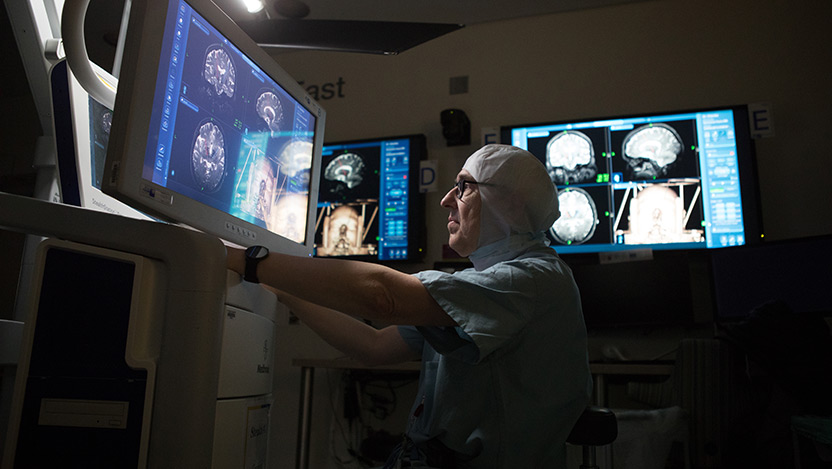
Advanced Parkinson disease can cause medications to become less effective over time. You might notice that your symptoms return before it is time for your next dose. Some patients also have trouble with the same dose that controls tremors causing uncontrolled movements called dyskinesia.
Deep brain stimulation (DBS) is a treatment option for patients facing these challenges. While DBS isn't a cure for Parkinson disease, it can help stabilize your symptoms throughout the day. Most patients can reduce their daily medication by about 50% after the procedure.
What Is DBS Surgery for Parkinson Disease?
DBS places thin electrodes into precisely targeted structures deep in the brain. Those electrodes connect to a small battery implanted under the skin near the collarbone. Once on, it delivers gentle electrical pulses that quiet the abnormal brain activity driving tremor.
DBS is not a cure. What it does — remarkably well in the right patient — is restore best hours of the day and extend them. Most patients also see a 30-60% reduction in levodopa.
At a Glance
- DBS is considered when medications still work but motor fluctuations, dyskinesia, or tremor interfere with daily life
- The best predictor of a good DBS response is how well you respond to levodopa — if levodopa helps, DBS usually helps more
- Typical patients see a 40-60% improvement in off-medication motor scores and cut their levodopa dose by about 50%
- The two main targets are the subthalamic nucleus (STN) and globus pallidus internus (GPi); both work, with different tradeoffs
- Focused ultrasound is an incisionless alternative for tremor-dominant patients who don't want an implanted device
Motor Fluctuations and Dyskinesia
- Wearing off — medication stops working before the next dose is due
- Unpredictable off periods
- Dyskinesia — involuntary twisting or swaying movements
- Taking levodopa every two to three hours just to stay functional
Tremor That Won't Quit
- Tremor that medication can't control
- Tremor that interferes with eating, writing, dressing
What DBS Cannot Fix
- Balance problems and falls that persist even when medication is working
- Swallowing trouble, freezing of gait in on-state, cognitive decline or dementia
Levodopa Challenge
Motor symptoms scored on UPDRS-III in off and on state. A 30% or greater improvement with levodopa is the threshold most teams look for.
Neuropsychological Testing
Significant cognitive impairment or dementia is a contraindication to DBS. Full neuropsych battery screens for this and also looks at mood.
Brain MRI
High-resolution MRI confirms the diagnosis is consistent with idiopathic Parkinson disease and is used to plan the electrode trajectory.
Medical and Surgical Screening
Since DBS is elective, the team ensures the patient is healthy enough to tolerate anesthesia.
Deep Brain Stimulation (DBS)
DBS surgery is typically performed in two stages. First, electrodes are implanted into the selected brain target. Second, a pulse generator (battery) is implanted under the skin near the collarbone and connected to the electrodes.
The most common targets are:
- Subthalamic Nucleus (STN) — often allows greater medication reduction
- Globus Pallidus Internus (GPi) — often preferred when dyskinesia is the major problem
Programming begins several weeks after surgery and may require multiple visits to optimize settings.
Levodopa and Medication Management
Even after successful DBS, most patients continue taking Parkinson disease medications, although doses are often reduced significantly.
Focused Ultrasound
Focused ultrasound creates a small lesion in a tremor circuit without an incision. It is most often used for tremor-dominant symptoms and does not require implanted hardware.
| Outcome | Rate | Notes |
|---|---|---|
| Improvement in off-medication motor symptoms | ~40-60% | Most predictable benefit in appropriately selected patients |
| Reduction in levodopa dose | ~30-60% | Often greatest with STN stimulation |
| Tremor control | ~70-90% | One of the most reliable benefits of DBS |
| Dyskinesia reduction | ~60-80% | Often improves through both stimulation and medication reduction |
| Hardware revision or replacement | Variable | Battery replacement required periodically depending on device type |
- Deuschl G, Schade-Brittinger C, Krack P, et al. A randomized trial of deep-brain stimulation for Parkinson's disease. N Engl J Med. 2006;355:896-908.
- Weaver FM, Follett K, Stern M, et al. Bilateral deep brain stimulation vs best medical therapy for patients with advanced Parkinson disease. JAMA. 2009;301:63-73.
- Bronstein JM, Tagliati M, Alterman RL, et al. Deep brain stimulation for Parkinson disease: an expert consensus and review of key issues. Arch Neurol. 2011;68:165.