
Second opinion for complex brainstem tumor offers new path for patient

When Mariam Hammoud learned she had a tumor deep within her brainstem, she faced a tough dilemma: pursue treatment without a biopsy, which could be ineffective, or have tissue extracted for testing from one of the body’s most delicate areas.
The brainstem contains critical pathways that control movement, sensation, speech and swallowing. Even a tiny injury in this region can have serious consequences.
“The margin for error is extremely small,” said Youssef Comair, MD, Section Chief of Neuro-Oncology and a neurosurgeon at the University of Chicago Medicine.
Doctors who initially cared for Hammoud said a biopsy would be too risky. Based on the tumor’s appearance on imaging, they gave her the option to proceed with radiation.
But Hammoud wanted to know more.
“How can you treat something when you don’t know what it is?” she said. “I wanted to understand what this tumor was so I could make the best decision moving forward.”
Hammoud had read about a complex spinal cord surgery performed on a toddler at UChicago Medicine after a severe car crash. She made an appointment with Mohamad Bydon, MD, Chair of the Department of Neurological Surgery, who referred her to Comair for evaluation.
For Hammoud, that second opinion would change the course of her treatment.
After frightening diagnosis, a new care team
Hammoud had been receiving regular MRI scans to monitor a small pituitary microadenoma, a benign tumor of the pituitary gland.
In May 2025, she started experiencing severe headaches, fatigue and vomiting. The 29-year-old accountant thought that stress might be responsible.
This time, an MRI revealed something new: a tumor involving her brainstem, which connects the brain to the spinal cord.
“My life changed in the blink of an eye,” Hammoud said.
When she arrived at UChicago Medicine, Comair and a multidisciplinary team reviewed her imaging and considered whether there was a way to safely obtain brainstem tissue.
For Comair, getting the full picture was important. That’s because modern treatment of brain tumors increasingly depends not only on what a tumor looks like on an MRI, but also its molecular and genetic characteristics.
“Before committing a young patient to a treatment that may have lifelong consequences, we wanted to understand exactly what we were treating,” Comair said.
Hammoud valued the approach.
“Dr. Comair didn’t want to shoot in the dark — he wanted every possible answer before making a decision that would affect the rest of my life,” she said.
Complex biopsy changes the treatment plan
The location of Hammoud’s tumor made a conventional needle biopsy very challenging.
It led Comair and his UChicago Medicine team to pursue an open surgical approach designed to reach the tumor while protecting the densely packed neurological pathways surrounding it.
Advanced MRI tractography helped them map critical nerve pathways in 3D and plan a surgical corridor to the tumor.
In March 2026, surgeons successfully obtained tissue from Hammoud’s brainstem tumor without causing any neurological damage.

Youssef Comair, MD, Section Chief of Neuro-Oncology at UChicago Medicine (Jordan Porter-Woodruff)
The biopsy provided critical new insights.
Molecular testing showed that Hammoud’s tumor carried an IDH1 mutation, allowing doctors to recommend customized treatment: vorasidenib, an oral targeted therapy for certain IDH-mutant gliomas.
“The biopsy gave us information that fundamentally changed what we could offer her,” Comair said. “Without tissue, we would not have known that this targeted treatment was an option.”
For Hammoud, it meant radiation could be deferred.
And it highlighted the value of second opinions and evaluation at a center with specialized expertise and technology for complex neurological problems.
“A second opinion does not mean the first opinion was wrong,” Comair said. “It means asking whether there are additional options before making a decision that may affect the rest of your life.”
The value of multidisciplinary care
Comair credits the neuroradiologists, neuroanesthesiologists, nurses, neuropathologists, neuro-oncologists and neurocritical care specialists who work together on a patient’s case.
“At a center with expertise across all of these disciplines, we can evaluate the problem from multiple perspectives and determine whether there are options that may not initially have been apparent,” Comair said.
These voices are helping fuel advances in personalized care. Molecular pathology, advanced imaging, surgery, radiation and targeted therapies can often be brought together to design treatment around the biology and location of a tumor.
The approach will inform the work that will happen inside UChicago Medicine’s new AbbVie Foundation Cancer Pavilion, opening in April 2027 as Illinois’ first freestanding facility dedicated exclusively to cancer care and research.
“I believe very strongly that bringing together cancer biology, neuroscience, neurophysiology and advanced surgical techniques can change the way we treat patients with brain tumors,” Comair said.

With team-focused care and monitoring, Hammoud is enjoying an active life. (Mark Black)
‘The right place and the right team’
Today, Hammoud feels well. She continues to undergo regular MRI scans and blood tests under the care of UChicago Medicine neuro-oncologist Lauren Singer, MD.
While her treatment has been effective, Singer and the rest of the team continue to plan ahead should the tumor’s behavior change.
“Dr. Singer told me to continue to enjoy my life, and I always think about that,” Hammoud said. “It gives me a lot of hope and motivation.”
In addition to the technology and surgical expertise that saved her, Hammoud is grateful for the doctors who carefully reconsidered a problem that seemed to have few options.
“They saw me as a person; someone with a family, with dreams, with goals, with a future,” she said. “I get emotional thinking about it, but I truly believe every step in this journey brought me to the right place and the right team.”
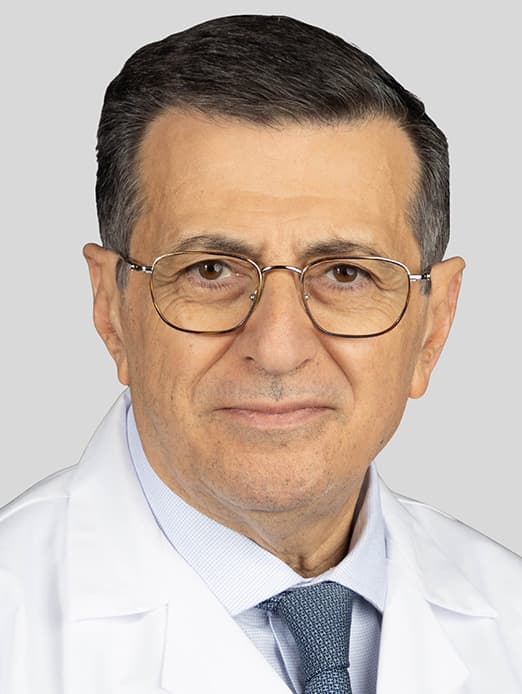
Youssef Comair, MD
Youssef G. Comair, MD, FRCSC, FANNS, is a world-renowned neurosurgeon who pioneered awake craniotomy for brain tumors and helped establish pediatric epilepsy surgery as a life-changing treatment for children with severe epilepsy.
Learn more about Dr. Kyeso
UChicago Medicine Comprehensive Cancer Center
UChicago Medicine is designated as a Comprehensive Cancer Center by the National Cancer Institute, the most prestigious recognition possible for a cancer institution. We have more than 200 physicians and scientists dedicated to defeating cancer.
Learn More About the Comprehensive Cancer Center