Natural Birth Techniques
Natural birth has a different meaning to different people. We want to know what it means to you.
The Family Birth Center offers you a customized natural birth experience in a safe hospital setting. We encourage you to have an open discussion with your obstetrician or midwife so our team can best prepare to uphold your expectations on the day you meet your newborn.
Register for our Natural Birth prenatal class
What Natural Birth Can Look Like
Movement During Labor
When you're in labor, our team can coach you through healthy exercises using special equipment, which may include peanut balls, birthing balls, squatting bars, labor stools and more. We encourage movement as one of many options to enhance comfort during labor and to help your delivery progress. Talk with your care team during your prenatal visits about what labor aids and equipment will be available to you.
Managing Your Pain
At the Family Birth Center at HP and Southland, you have options to manage labor pain with natural methods and epidural alternatives — as long as it's safe for you and your baby.
We offer natural, unmedicated labor pain management options, including warm water immersion therapy (hydrotherapy) in our birthing tubs at our Family Birth Center - Hyde Park location.
Even if you choose or need to have an epidural, our anesthesiology experts specialize in effective epidural pain relief without loss of sensation or mobility.
Cervical Ripening and Inducing Labor
If your cervix has not dilated (started opening) and it has been determined by you and your doctor that it is time to have your baby, your physician or midwife may advise cervical ripening to help prepare you for labor. At the Family Birth Center, we offer multiple options to dilate the cervix or induce labor, including medications and cervical ripening balloons.
What is a cervical ripening balloon?
A catheter (a thin, flexible tube) with a balloon attached is passed through your cervix by a physician or midwife. As the balloon is filled with saline, it applies pressure that helps to dilate the cervix in preparation for labor.
Discuss Options With Your Care Team
Our experts can help you understand your personal options and offer evidence-based insight to help you choose the best approach for you and your baby. For some patients, one method is effective, while others may try more than one option.
Vaginal Delivery
When possible, a safe vaginal delivery is always the first option — even for some women who have had up to two prior cesarean births (C-sections), with TOLAC/VBAC. Yet under certain circumstances, a C-section may be the safest delivery option for you, your baby, or both of you. Whether you deliver vaginally or by "gentle" or "natural" cesarean, our team commits to remaining attentive to your priorities as you experience your child's birth.
Episiotomy
With little evidence supporting its benefit as a birthing practice, our experts rarely perform episiotomy. If you can safely deliver without an episiotomy, our team will support your preference to not have one.
Delayed Cord Clamping
Our specialists delay cord clamping at birth to maximize healthy blood flow to the baby from the placenta. Waiting to cut the umbilical cord — at least 30 seconds or until pulsations stop — is an evidence-based practice associated with many benefits for newborns, including healthier circulation, lower iron deficiency anemia rates and lower jaundice rates.
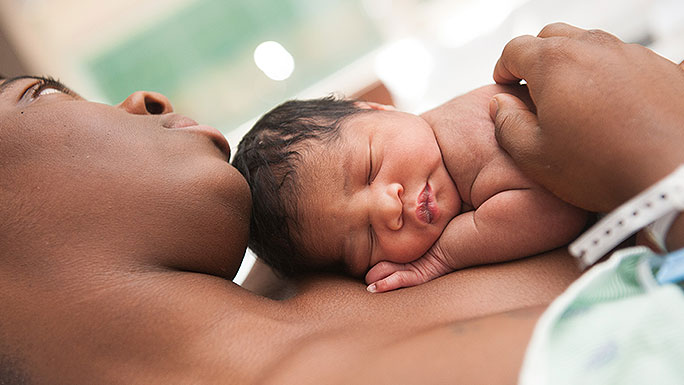
At the Family Birth Centers, you can even start skin-to-skin (kangaroo care) before the umbilical cord is cut.
Bonding With Your Newborn
We encourage immediate bonding after vaginal and cesarean deliveries. At the Family Birth Centers, we routinely follow evidence-based best practices, such as skin-to-skin (kangaroo care), rooming in (couplet care) and early breastfeeding.
Natural Labor Pain Management Techniques
Our team offers several natural and low intervention pain management options. If it's safe for you and your baby, you may even choose not to take pain medication at all.
Two Chicagoland Family Birth Centers: Hyde Park and Harvey
With birth centers at our Hyde Park campus and at UChicago Medicine Ingalls Memorial in Harvey, the University of Chicago Medicine also offers personalized prenatal care in several convenient locations for Chicagoland families. Learn more about the specialists on our care teams, available locations for prenatal care, and the remarkable care you'll experience when you choose our Hyde Park or Harvey birth centers.