
The making of a community health worker starts at home
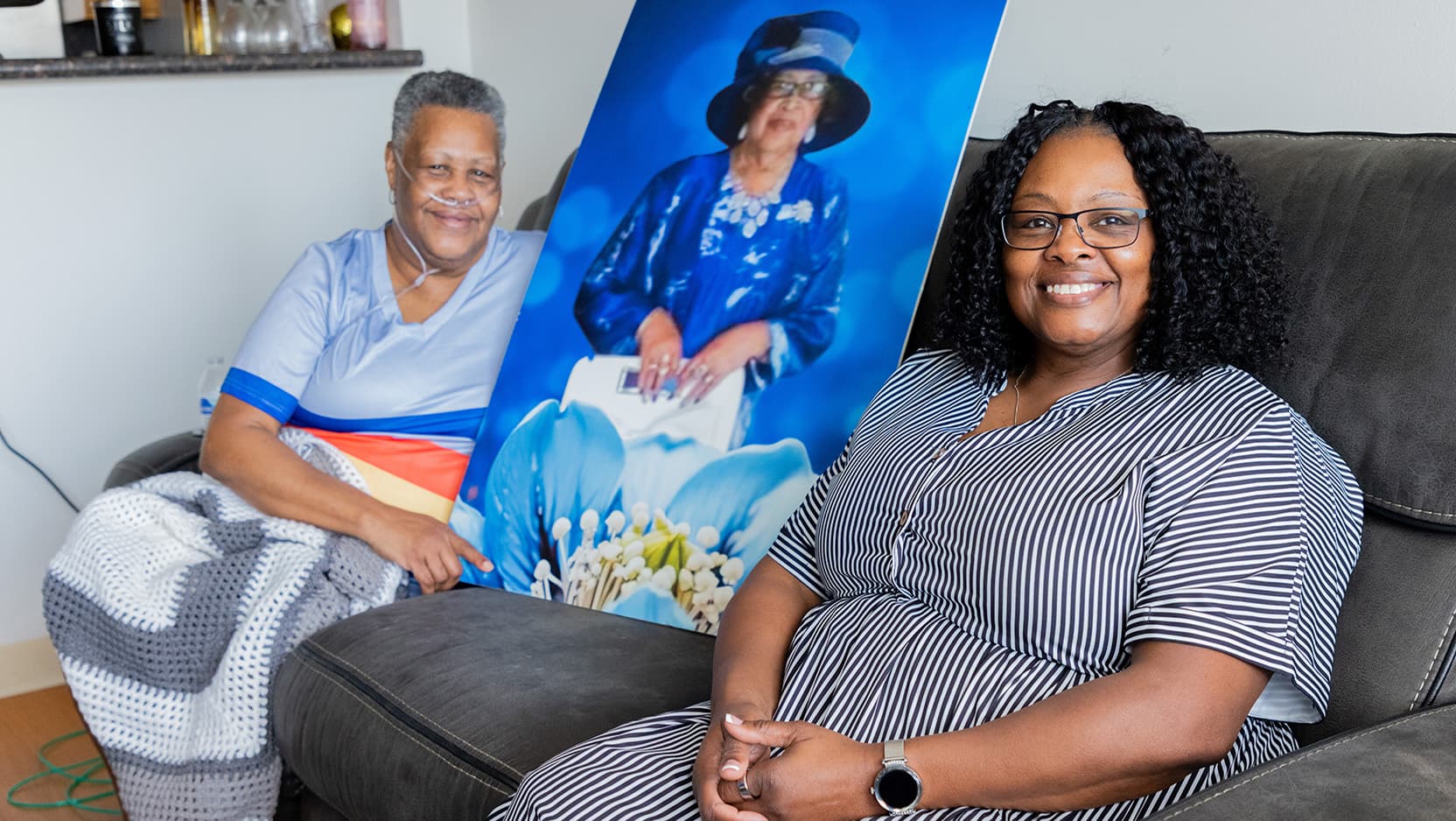
From left: Rachel Richmond, an image of her mother, Johnnie B. Richmond, and Rachel's daughter, Felita Idugboe.
When EB, a UChicago Medicine community health worker, went to Rachel Richmond’s house in 2021 to arrange the care Richmond would need after a stroke, Richmond’s daughter met her with a binder full of paperwork, already completed.
Felita Idugboe knew as much as her mother did about the condition, the recovery activities and the medications, and she had already made the arrangements EB had come to make.
"When she arrived, unbeknownst to her, I had already handled all the referrals," said Idugboe, now a community health worker (CHW) at UChicago Medicine. "I scheduled all the appointments. I scheduled outpatient therapy. I had gotten her medications. I set up home health services. I did everything."
During her hospital stay at the University of Chicago Medical Center, Richmond enrolled in the Liaisons in Care program (LinC), which is operated by the Urban Health Initiative, the health system’s community health division. LinC places community health workers with patients managing chronic conditions, including asthma, diabetes, high blood pressure and cancer, and connects them to resources like transportation, housing and food. Its community health workers come from the same neighborhoods as the people they serve, which lends trust and credibility to the relationships they build. Last year the team reached more than 2,400 patients across the medical center and UChicago Medicine Ingalls Memorial.
EB recognized what she was looking at, because a few years earlier she had kept a binder of her own.
When her mother was being treated for cancer, EB tracked every recommendation, medication, appointment, warning and insurance question. Years later, interviewing for a job as a community health worker, she mentioned the binder. The interviewer, community health worker manager Dameka Edwards-Hart, told her what the binder signified.
"Dameka told me, ‘Oh, so you’re already a CHW,’" EB said.
When EB walked into Rachel Richmond's house, she saw Felita's binder. "There I was, on the other side of the table," she said. "Now I saw what Dameka had seen. Felita was already a CHW."
Idugboe was a certified nursing assistant who had stepped back to manage her mother's recovery. EB asked whether she had ever thought about becoming a community health worker.
"I had never heard of that position," Idugboe said. "She told me it was pretty much what she does. She said, you’ve done my job."
Idugboe grew up on the South Side, where her maternal grandmother, Johnnie B. Richmond, modeled what community service looked like, working at Rainbow PUSH and the Chicago Housing Authority and volunteering for her church and neighborhood. Whenever her grandmother volunteered for something, Idugboe was volunteered too.
Idugboe grew into the same habit on her own. Friends brought her their problems. Neighbors brought her paperwork they could not make sense of. She would go looking for the answer, find it and pass it along. When her children’s school sent home information about a resource, she made sure the other parents knew about it, too.
"I was just actively doing the role without the title," she said.
What EB saw in the house went beyond the binder. Community health workers work with patients to reach their recovery goals, and Idugboe had already worked out what recovery meant for her mother. She encouraged her mother to tell EB about the things she wanted back in her life following the stroke: caring for her bird, doing her Sudoku, crocheting, walking to the bus stop on her own.
"Those are the tangible signals to the patient that life is theirs again," EB said, "which is critical for a sense of wellbeing."
EB says she has seen plenty of families step into caregiving for a relative. Idugboe was different.
"I’ve met many wonderful relatives and friends who have shaped themselves into community health workers for the love of someone with health challenges," she said. "Felita is the only person I have met who openly said, ‘I would love to be doing this for others.’"
EB told her managers about Idugboe, and when an opening came up she was hired. Idugboe started as a community health worker in November 2022, spent about a year and a half working with cancer patients and then moved to helping patients with diabetes.
She now plays a key role in the Emergency Department Diabetes – Linkage to Care initiative, which reaches patients whose bloodwork showed an A1C in the diabetic range during an emergency room visit, even when they came in for something unrelated. Idugboe calls them, explains what the result means and helps connect them to a primary care doctor or an endocrinologist.
"Felita is a passionate CHW who brings a sense of purpose to the work we do," said Mary Kate Wagner, director of community health worker programs. "She recognizes the seriousness of a diagnosis like diabetes going unaddressed and is driven to bring healthcare to people and communities that often go underserved. She has served in a caregiver role in her own family, so Felita’s depth of empathy comes from a genuine place of understanding."
"I meet patients where they are," Idugboe said. "It’s a no judgment zone."
Patients who enroll in the LinC program get a plan built around what they need. For example, Idugboe helps those without coverage apply for insurance, explains what a medication does and when to take it, and can point someone toward a farmers market program that matches what they spend in food benefits. Most patients finish the program in three to six months, once they have a provider, appointments they can keep and the confidence to speak up for themselves.
"We don’t call it an exit," Idugboe said. "We call it graduation." Even so, she still gets two or three calls a week from program graduates.
Community Benefit Questions?
Contact us with questions about community benefits, including grants and sponsorships, offered by UChicago Medicine.
Email our team