
Soothing spaces and smart tech: 5 ways UChicago Medicine’s new cancer pavilion is designed for healing
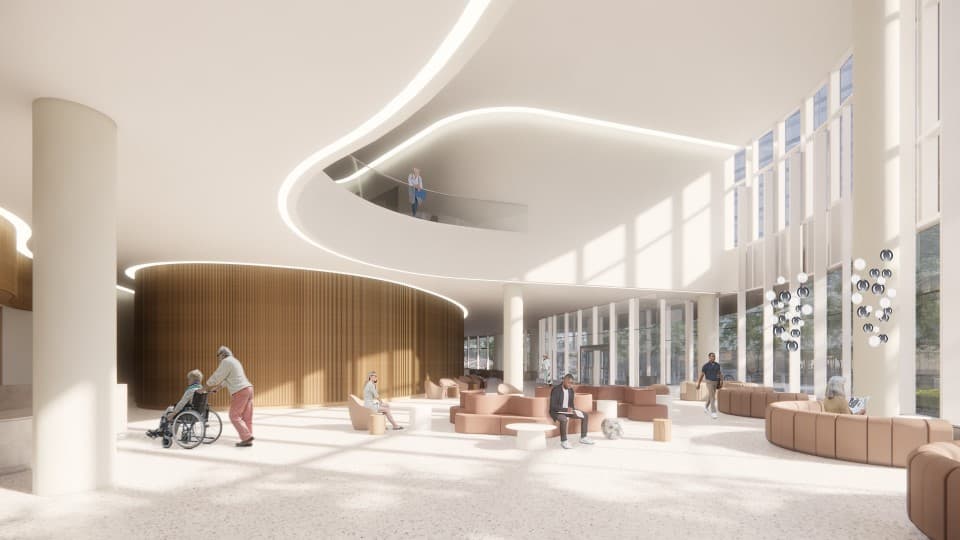
From the wall colors to the curves of the furniture, every detail in the AbbVie Foundation Cancer Pavilion at the University of Chicago Medicine is designed to bring comfort and convenience.
That’s in addition to the leading-edge technology and research capabilities housed inside the pavilion, which will be Illinois’ first and only freestanding facility dedicated to cancer.
Set to open in April 2027, the pavilion incorporates natural elements, input from patients and staff, and a community-minded approach to public spaces, both indoors and out.
With one year to go, UChicago Medicine designers and construction leaders shared several unique features of the project.
1. Natural elements and daylight throughout
Autumnal and dark green hues, as well as natural wood tones, will set a calming tone throughout the 575,000-square-foot space. The sun shines in, too: The seven-story pavilion’s glass exterior supports abundant natural light for orientation, mood and circadian rhythms.
The look follows what’s known as a “biophilic” design philosophy, said Erika Turckes, the Assistant Director of Interiors and Architectural Design at UChicago Medicine.
In other words, “the aesthetic is rooted in nature and the environment,” Turckes said.
Furniture will have soft curves and gentle edges instead of straight lines. Large glass panels will show close-ups of nature, such as Ginkgo leaves or feathers (real plants can’t be used for safety reasons) to support a peaceful mood that helps patients feel at ease.
2. Patient and staff feedback in design choices
When it came to furniture choices and room layouts, the pavilion’s team listened carefully to those who will use the building the most.
“We called on the wisdom of our patients, community and staff as much as possible,” Turckes said.
Consider the recliners coming to infusion suites: Turckes described a “Goldilocks test” where families and staff sat, stretched and voted for their favorites, including models with heating and massage. They also tested sofas with wider arms and USB ports for inpatient rooms.
Clinicians and anesthesiologists evaluated chairs that would be the most comfortable to use while on the job. And, in mock patient rooms, nurses and doctors set up medical equipment to decide where everything would work best, down to where light switches are placed.
3. Simple, soothing color schemes
Learning from past designs, the team decided to keep color choices simple. Instead of having many different accent colors by location, the pavilion uses color by function.
“The introduction of accent colors will be limited to the type of room: Exam rooms are clay-colored, infusion rooms are green and inpatient rooms are blue,” Turckes said. “It is simpler and provides a more consistent experience for the patient.”
Beyond helping with navigation, the palette gives the entire building a soothing, unified look.
4. Purpose-driven technology at every turn
The pavilion is packed with tools to give patients and families more control during their stays, and even the smallest details are intentional.
“Every element of the pavilion’s technology strategy was built around the patient experience,” said Marco Capicchioni, UChicago Medicine’s Vice President of Planning, Design, Construction and Real Estate.
Among the features: bedside tablets to control a room’s lighting, temperature, blinds and entertainment, as well as handle nurse calls and food orders. AI-enabled monitoring will offer real-time virtual nursing and extra safety, and automated robots will deliver medications.
Exam rooms will have video-enabled displays for loved ones to join appointments remotely. “Anyone who’s ever tried to listen in on a visit via cellphone will appreciate how much easier this will be,” Capicchioni said.
5. Intentional spaces for community, family
At its heart, the pavilion is designed for connection. The ground floor offers a “town square” featuring a community gathering space, as well as a gift shop, cafe, wellness center, holistic oncology services, therapy rooms and a nondenominational chapel.
Outdoor gardens, terraces and a pocket park will give patients access to fresh air and sunlight, even if they can’t leave their floor.
Other offerings cater specifically to those coming to visit patients. The pavilion — which offers 80 inpatient beds, 90 exam rooms and 67 private infusion bays organized by cancer type — will feature family lounges, laundry and shower facilities, and pull-out sleeper sofas.