Facial Reconstructive Surgery at UChicago Medicine
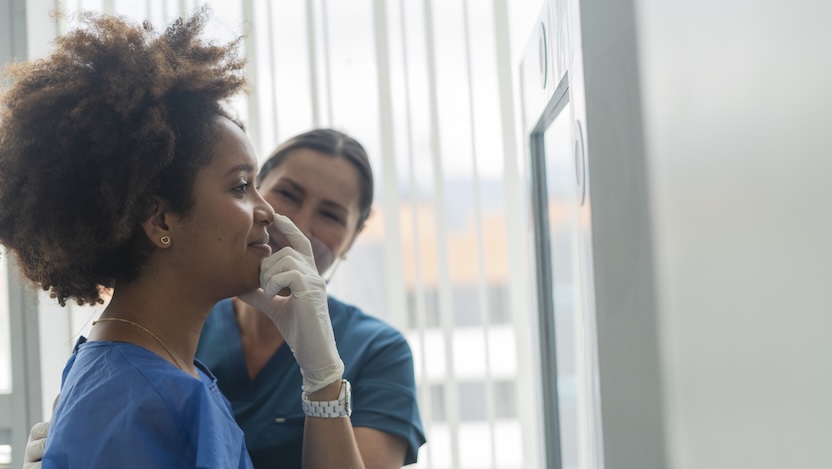
Our reconstructive program restores both form and function after trauma, cancer treatment, illness or birth defects. Using advanced techniques and artistic precision, board-certified surgeons at UChicago Medicine provide world-class care to help you look like the best version of yourself – refreshed, confident and naturally you.
Facial Cancer Reconstruction
This surgery restores appearance and function after the removal of skin or tissue cancers, such as basal cell carcinoma, squamous cell carcinoma or melanoma. The goal is to rebuild areas of the while ensuring results remain as natural and functional as possible.
- Removal of skin cancers (basal cell, squamous cell, or melanoma).
- Restoration of facial symmetry after tumor removal.
- Improving essential functions like breathing, blinking, or speaking.
- Reducing visible scarring to improve quality of life.
- Local Flaps: Tissue from nearby areas is moved to cover the wound.
- Skin Grafts: Skin is taken from another part of the body to replace missing tissue.
- Free Tissue Transfer: Tissue with its own blood supply is moved from another body area for larger repairs.
- Combination Approaches: Multiple techniques are used to match skin color and texture perfectly.
Facelift Parotidectomy
A parotidectomy using a facelift incision removes a benign parotid gland tumor through an incision hidden behind the ear, helping minimize visible scarring.
In rare cases, removing a large parotid tumor leaves a bigger space that needs to be rebuilt. Free tissue transfer uses healthy tissue from another part of the body to restore the shape of the face and help protect the facial nerve.
Learn about free tissue transfer.Most patients who need reconstruction after a facelift parotidectomy can be treated with tissue from nearby areas. Locoregional flaps help fill the space left after the parotid gland is removed, restore the natural shape of the face and reduce a sunken appearance.
Learn about locoregional flaps.Mohs Reconstruction
Mohs reconstruction is the repair process performed after Mohs surgery removes skin cancer. Once the cancer is gone, our surgeons restore the shape and function of delicate areas like the eyelids, nose, or ears.
- Deep or wide defects left by skin cancer removal.
- Restoring a natural look to the face.
- Preserving the function of critical features like the lips or eyelids.
- Minimizing scarring.
- Primary Closure: Small wounds are stitched closed directly.
- Skin Grafts: Skin is relocated to cover larger areas.
- Local Flaps: Nearby skin is rearranged to cover the defect and hide scars in natural lines.
- Surgeons carefully plan the repair to achieve the best cosmetic result.
Facial Trauma Repair
Facial trauma surgery repairs injuries to the face caused by accidents, sports, or violence. The goal is to put the facial structures back together safely to restore symmetry and function.
- Broken noses, cheekbones, jaws or eye sockets
- Deep cuts that require precise closure
- Damage that affects chewing, speaking or vision
- Scarring or asymmetry from past injuries
- Assessment: Imaging (CT scans) is used to find fractures
- Closed Reduction: Broken bones are moved back into place without incisions
- Surgical Repair (ORIF): Plates or screws are used to fix bones in place through small incisions
- Soft Tissue Repair: Cuts are carefully closed to minimize scarring
Nasal Valve Repair
Nasal valve repair improves breathing when the narrowest parts of the nasal airway are collapsed or weak. This procedure strengthens the nose structure to allow better airflow.
- Difficulty breathing through the nose during exercise or sleep
- Nasal passages collapse when you inhale
- Previous nose surgery weakened the structure
- Chronic congestion persists despite medication
- Surgical Repair: Weak cartilage is supported with grafts taken from the septum or rib
- Vivaer® (Non-Surgical): Radiofrequency energy gently reshapes the nasal valve to improve airflow without incisions
- This is often combined with rhinoplasty for both cosmetic and functional improvements
Septoplasty
Septoplasty is a surgery that straightens the nasal septum (the wall between your nostrils). When this wall is crooked, it blocks airflow and makes breathing difficult.
- One or both nostrils feel blocked
- Chronic sinus infections or nosebleeds occur
- Snoring or sleep issues affect rest
- You have a deviated septum
- Incisions are made inside the nose so there are no external scars
- Deviated bone or cartilage is trimmed or repositioned
- Internal splints may be used temporarily to support healing
Turbinate Reduction
Turbinate reduction decreases the size of the structures inside the nose that filter air. When these structures are too large, they block airflow and cause congestion.
- Nasal congestion does not improve with allergy medication
- It is hard to breathe through the nose
- Snoring or sleep breathing issues are present
- Submucosal Resection: Excess bone or soft tissue is removed while preserving the lining
- Radiofrequency Reduction: Energy is used to shrink the tissue with minimal trauma
- This is often performed alongside septoplasty or nasal valve repair
Scar Revision
Scar revision improves the texture, color, or shape of scars caused by surgery, injury, or acne. The goal is to make the scar blend in with the surrounding skin.
- Scars are raised, thick, or wide
- Scars look depressed or sunken
- Tight skin over a scar limits movement
- Scars are red or highly visible
- Excision: The old scar is removed and the skin is re-stitched for a thinner line
- Z-Plasty: The direction of the scar is changed to hide it in natural creases
- Laser Therapy: Light energy is used to smooth the skin surface