
‘Walking-miracle stuff’: Minimally-invasive robotic spine fusion surgery cures woman’s severe leg pain

Kara Galbraith knew something was off when her right leg began to feel strange during her daily walks.
“It was kind of hurting, but not really bad,” said Galbraith, 59. “I kept walking and thinking, ‘just push through it, whatever.’”
A decade ago, Galbraith was diagnosed with spondylolysis — a lower back stress fracture often caused by sports injuries due to repetitive back motions or overuse. (For some people born with thinner vertebra, the series of small bones that make up the spine, the cause is genetic.)
Treating the fracture is key to preventing serious spinal damage.
Left unaddressed, it can lead to spondylolisthesis, which happens when a stress fracture worsens over time and allows the vertebra to move abnormally. That movement causes alignment issues, pain and a risk for even more damage.
Scans revealed spondylolisthesis in Galbraith’s lower spine.
Galbraith isn’t sure why she developed either condition. She tried to exercise to help reduce her lower back pain, but the discomfort led her to see her primary care doctor in the fall of 2024.
Choosing the right doctor for spine surgery
Doctors diagnosed Galbraith with a pinched nerve. The symptoms, she was told, could be treated with physical therapy, pain medications, steroid or numbing injections, or surgery.
Galbraith tried physical therapy and a steroid injection, but neither helped. She then saw a neurosurgeon, who suggested fusing together the two vertebrae in question to stabilize her spine and reduce pressure on the irritated nerve.
Fusion surgery can be complex — especially with a damaged spine like Galbraith’s — so she reached out to a national expert in complex spinal surgery: Mohamad Bydon, MD, Chair of the Department of Neurological Surgery at the University of Chicago Medicine.
“She had a significant amount of movement — over two centimeters, which is a lot — between the L5 and S1 vertebral bodies of the spine,” said Bydon, who worked at another healthcare institution during Galbraith's initial consult.
But surgery would have to wait: A bone density test revealed Galbraith had osteoporosis, or loss of bone.
Osteoporosis increases the risk of bone fractures and makes spine surgery riskier because the weakened bones heal more slowly, and the screws used to stabilize the spine are more likely to loosen or fail over time.
“I could have just cried,” said Galbraith, who, despite her faith and the help of pain relievers and hot packs, couldn’t even make it one block to church. “I was very concerned about whether I was going to be able to walk again.”
Still, she persevered.
“I researched all of the neurosurgeons to see who specialized in my area,” said Galbraith, a resident of Laurium, Michigan, in the state’s Upper Peninsula. “Dr. Bydon was by far the person, no question.”
Less invasive surgery for spinal fusion
UChicago Medicine’s Comprehensive Spine Center offers multidisciplinary evaluations and treatments, including nonsurgical options.
Neurosurgeons and orthopaedic surgeons use minimally-invasive methods whenever possible to treat degenerative changes, nerve damage, trauma, infection and structural abnormalities — all with the goal of reducing or eliminating spine pain.
Spondylolisthesis surgery has historically been invasive. It involves a large incision in the back so doctors can move aside muscles to reach the spine, decompress the nerves by removing pressure on them, and then realign and fuse the vertebral bone with bone grafts, screws and rods.
New options are available. Bydon has spearheaded robotic and minimally invasive techniques for 10 years to help reduce surgery times and incision lengths for patients.
Last September, he performed a robotic spinal fusion surgery for Galbraith at UChicago Medicine. It took him roughly 75 minutes to fuse her vertebral bones through an incision the size of a grape.
“This approach meant we could avoid a large open incision and a lot of muscle dissection, as well as blood loss,” said Bydon, who is also Health System Leader for Neurological Surgery at UChicago Medicine.
“We were also able to avoid fusing more than one level of her spine, which means she has more movement than she would have in a more traditional surgery.”
For Galbraith, the relief was immediate.
“As I woke up, there was no pain in my leg,” she said. “As soon as they got me up to walk, I could walk.”

Active and ‘fired back up’
Three months later, Galbraith returned to work as a patient advocate and administrative secretary at a local hospital, and she didn’t require physical therapy.
Now focused on getting back in shape before the birth of her first grandchild, Galbraith takes short walks several times a day, and she closely follows all of Bydon’s directives.
“Everything is getting fired back up, little by little,” she said. “There are no shortcuts to a successful recovery from this kind of surgery — slow and steady wins the race.”
Galbraith still looks back on the surgery with astonishment.
“It was amazing, I mean walking-miracle stuff,” she said. “That's how I describe it to people.”
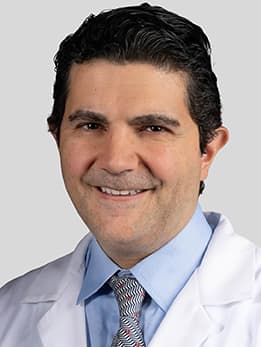
Mohamad Bydon, MD
Mohamad Bydon, MD, is a compassionate and highly skilled neurosurgeon specializing in complex spinal conditions. International patients from global destinations, as well as national patients from across the United States, seek his expertise in robotic, minimally invasive and endoscopic spine surgery.
Learn more about Dr. BydonSpine Care
The University of Chicago Medicine spine team offers a wide range of non-surgical, minimally invasive and traditional proven surgical techniques for the treatment of back and neck problems.
Read more about our spine services